Enterprise Workflow Reframe
For a staffing agency manually processing as many as 10,000 weekly job applications at its peak, I lead research and design to optimize the manual workflow tools improving speed and reducing redundancies with a new framework for automated processing and repeatable tools.
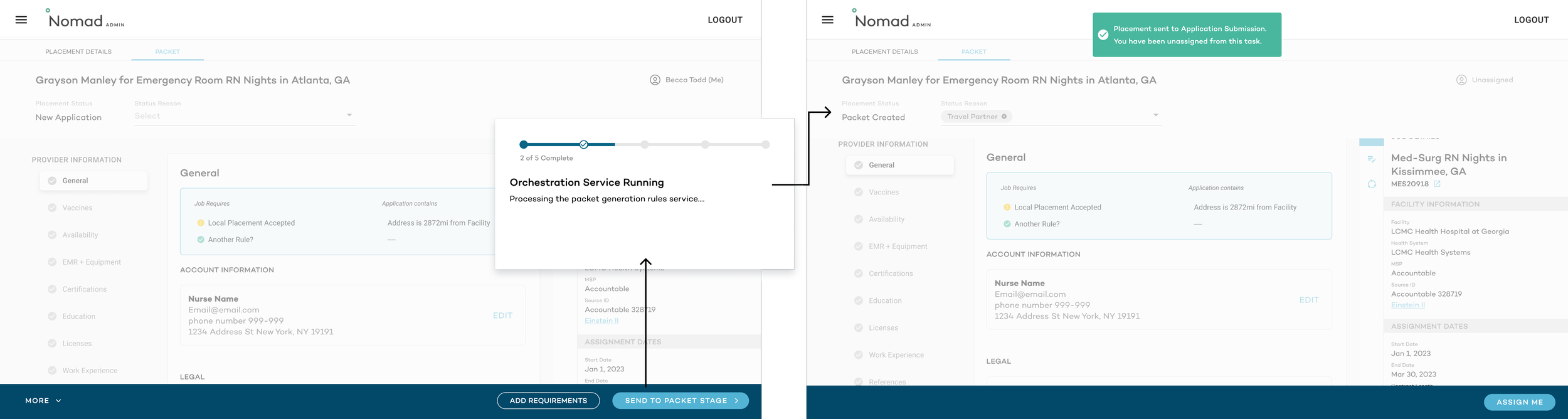
Context + Overview
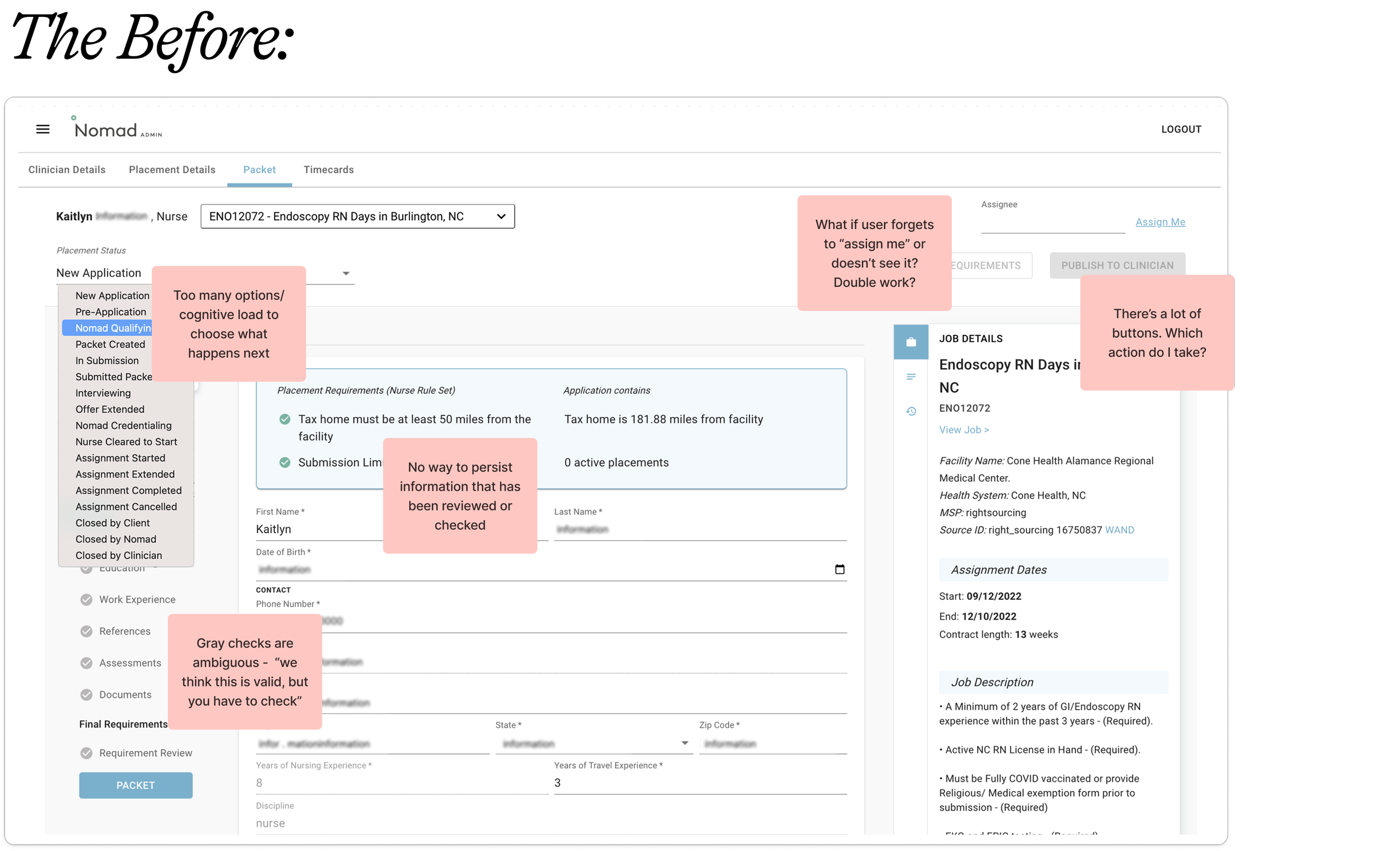
Nomad’s internal tooling that operations teams used to review and process candidates was in poor shape and not conducive to the immense volume at peak times during the Covid seasons. This project was focused on developing a solution to mitigate the improve operational efficiencies and duplicative workflows for the people who use this tool 40 hours each week.
My Role: I led research with cross-functional partners across 6+ internal departments who would use the tool, and designed the linear workflow framework for each team.
Project Scope: Redesign overall framework and create new tools within the desktop app. The new framework was built atop a new automated service platform in tandem with engineering teams developing it. Once built, the new framework was used by 4 operational teams for application review, processing, and submissions of Nomad’s 10,000 weekly applications.
The Impact: The framework removed and consolidated actions for efficiency optimizations of 88% improvement, from 36 clicks to 4. Within the framework, repeatable patterns like the persisting credential review reduced duplicative work by 26%
Background
As a digital staffing agency, Nomad’s internal software serves clinician operations for the business, and is used by operations teams to complete all steps necessary to get a clinician to the bedside:
Review and post jobs
Review clinician profile data
Evaluate applications
Submit applications to clients
Manage and create job offers
Credential clinicians to prep for assignments
Monitor clinicians on assignment
Additionally, clinicians were often applying to more than one job at a time, but application-specific data didn’t persist from one application to another creating a lot of duplicate information for clinicians and activity for internal operations teams.
Problem + Opportunity
The business opportunity for Nomad was to build out operational processes on top of a new backend service platform to meet business efficiency goals. We wanted to build the existing application review tool on top of the new backend service to allow:
Improved operational efficiencies
Faster speed (which directly affects likelihood of a clinician receiving an offer)
Additional internal improvements to collect more precise data for continued improvements to workflow efficiencies and business insights.
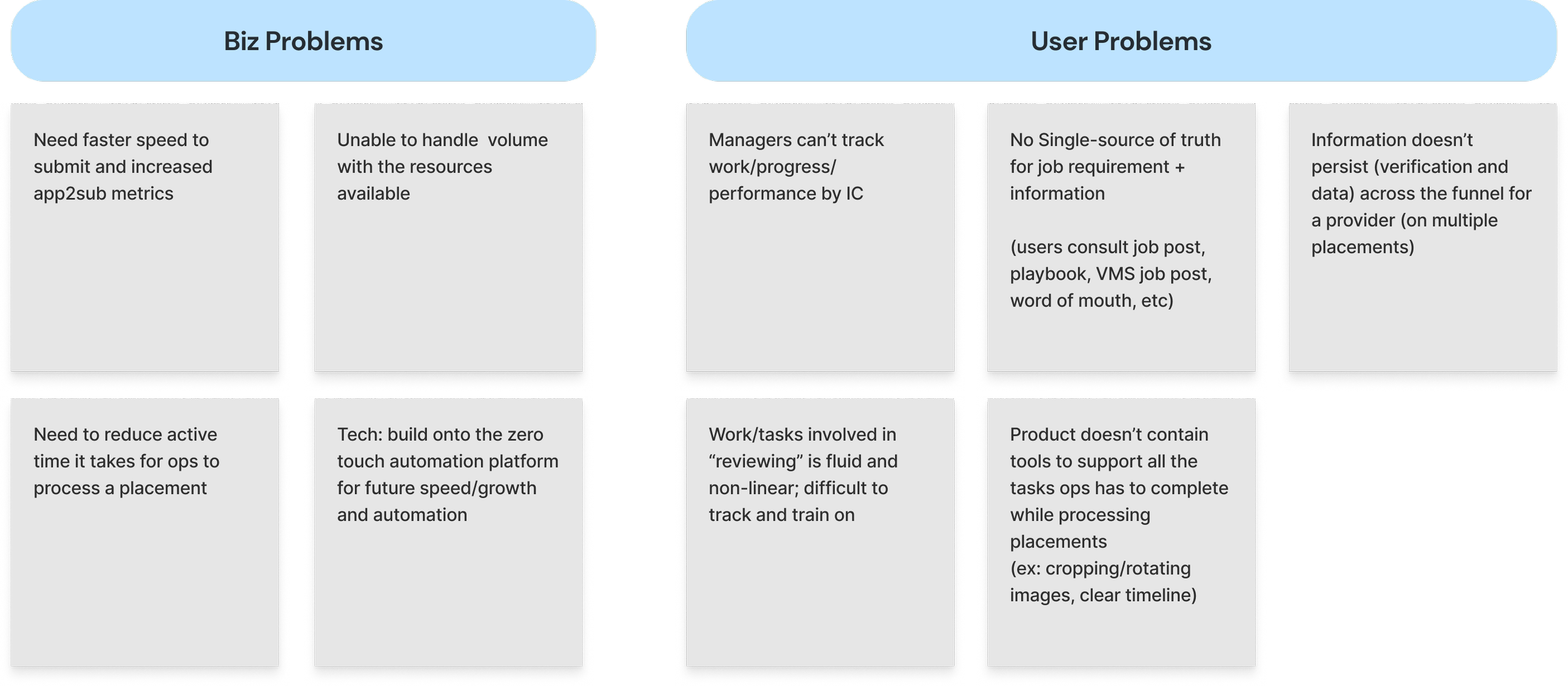
The question remained of where to apply the new service first, and what user problem to tackle first. I worked with my product partner and cross-functional stakeholders in a design-thinking workshop to explore the problem space and align on what we should solve for first with the new automation service.
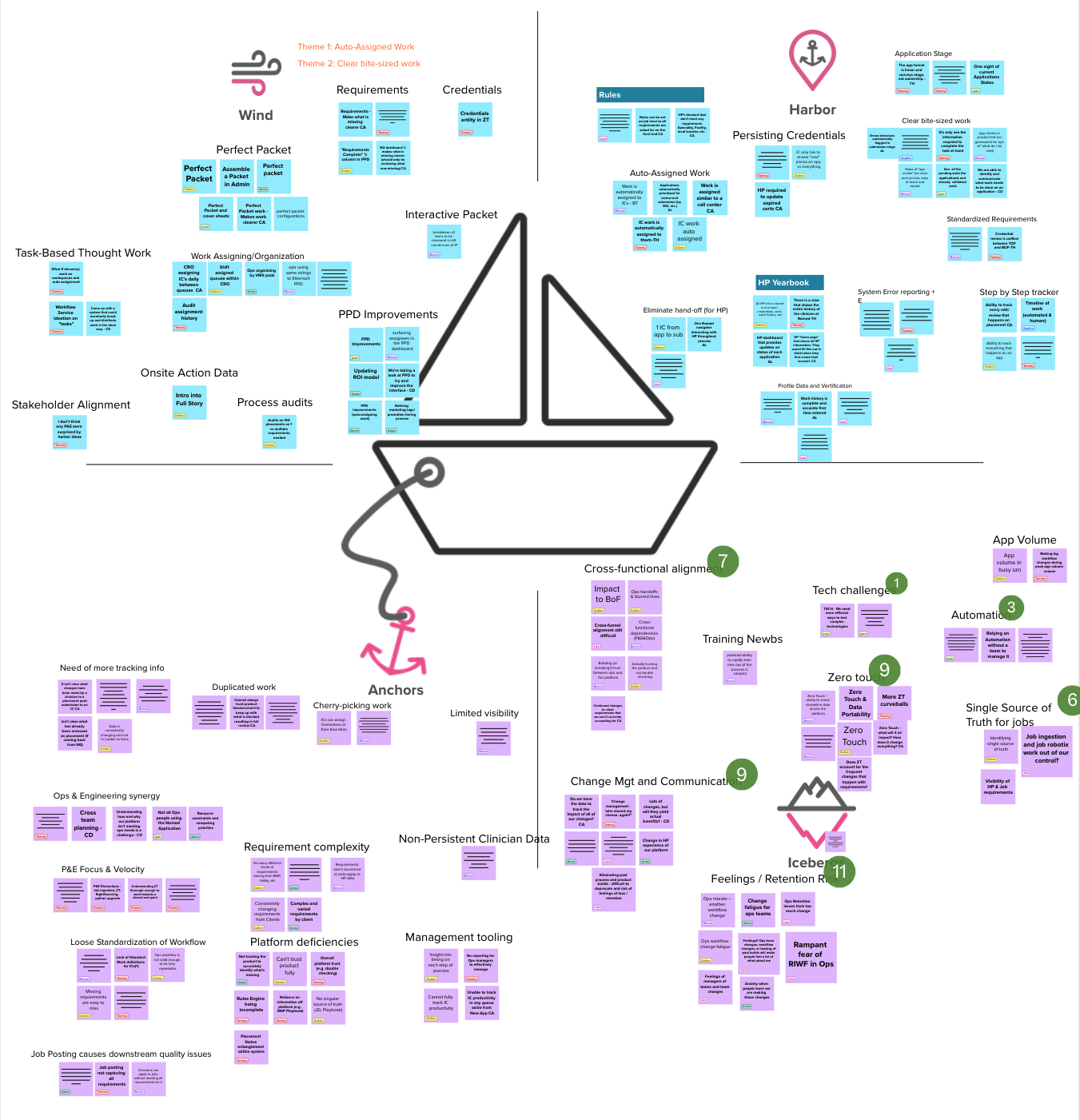
Through workshopping, we determined the core user problems to solve included streamlining the varied tools for a linear, exception-based workflow:
Empower operations teams to trust new automation with clear interface and repeated UX patterns
A backend refactor was the perfect opportunity to improve the frontend workflow into a linear flow. At the time, operations teams leveraged several workarounds to do what they needed to get done, so we worked to systematize their operations with functional controls.
Research
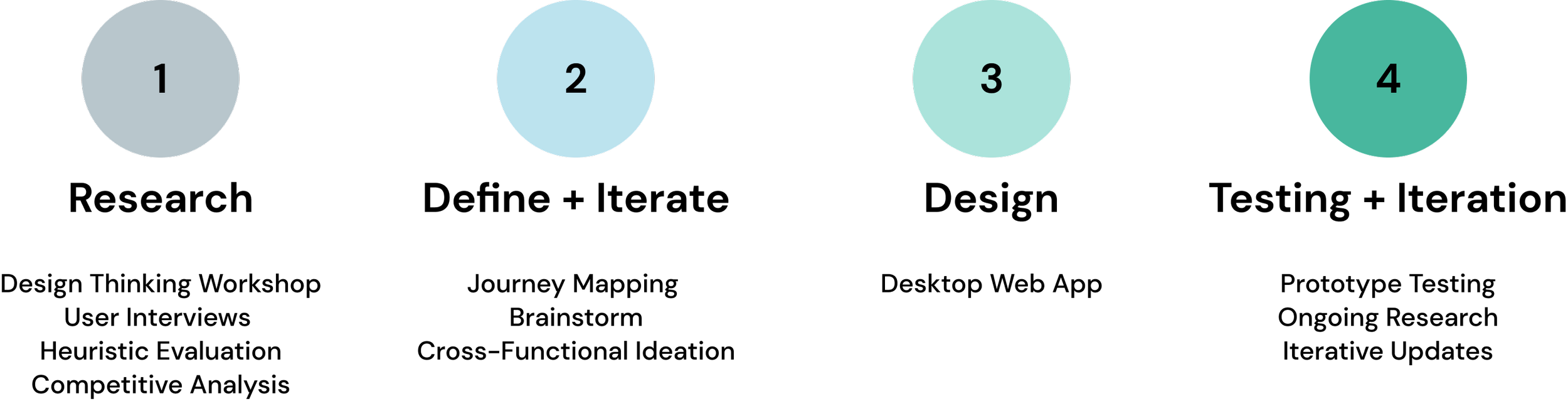
To more acutely define the core problems and begin to understand what problems we should solve, I began research and discovery with the existing tools being used.
User Interviews
I leveraged shadowing sessions to better understand nuances of workflows amongst teams and what their ultimate goals were. I shadowed 12 team members from 4 different teams to understand current product pain points and various workarounds that could be streamlined.
I encouraged engineers and our product manager to join sessions to increase their user empathy and give a clearer picture to what we’re hoping to achieve.
Heuristic Evaluation
I reviewed each page of the current tool to better understand what could be improved. In combination with information gleaned from shadowing sessions, this allowed me to pinpoint broken windows that were causing workflow bottlenecks.
Journey Mapping
I created in-depth user journey maps to review with the product manager and engineers and collaboratively arrive at the best path forward. Because this project was largely a technical endeavor (to leverage a new backend service), I wanted to work closely with them to ensure we were building the most optimal product.
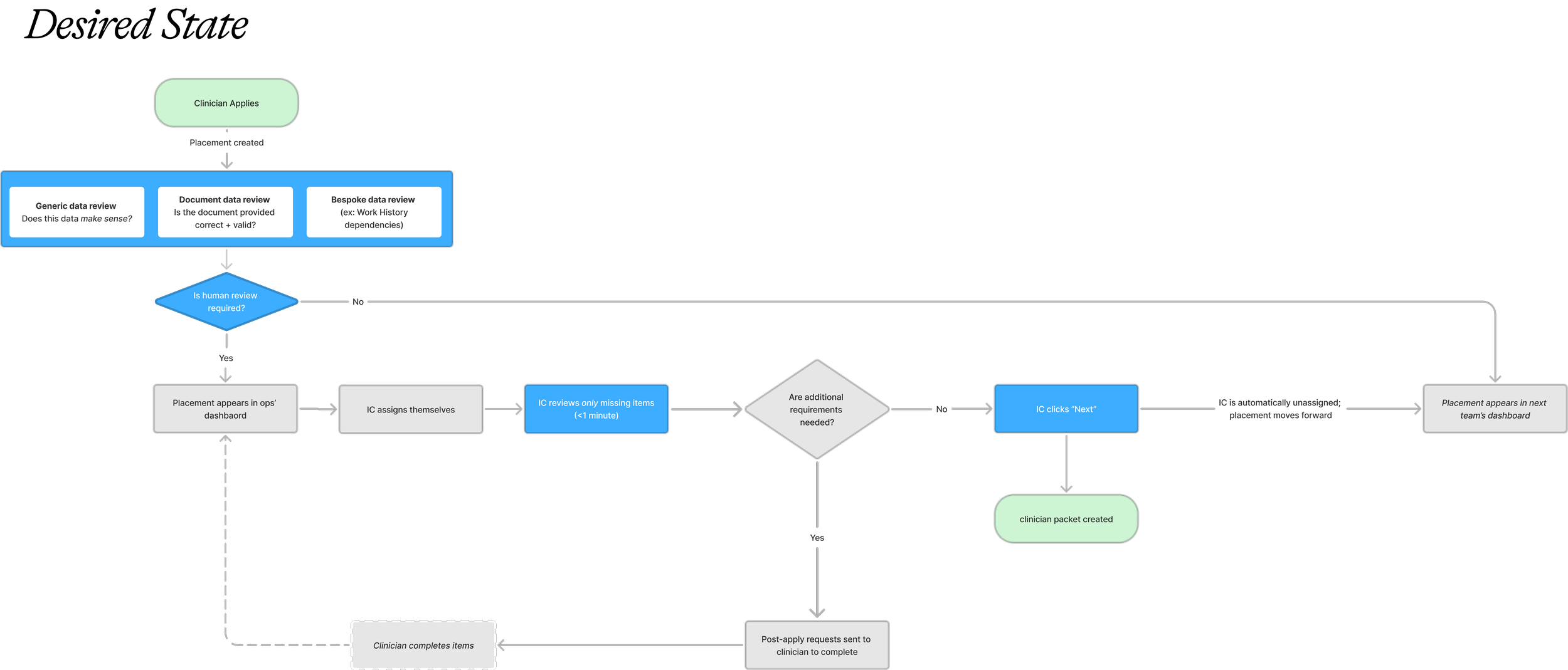
Understanding the deeper problems across both business and users and the problem scape allowed me to work from the following core questions. I collaborated with my product partner for clarity and sought alignment with stakeholders as we moved forward:
How might we automate tasks to optimize necessary manual time for speed gains?
How might we remove duplicative work?
How might we display and propagate data in a trustworthy way so that our teams trust the product?
Design
With such in-depth research and understanding of end-users, I was quickly able to pinpoint the core user problem and move quickly to idea generation with engineering and product partners. I experimented with a two different concepts that would remove ambiguity of the workflow to steer users through it linearly; one was more task-centric to the each individual section, whereas the other maintained a more generalized framework.
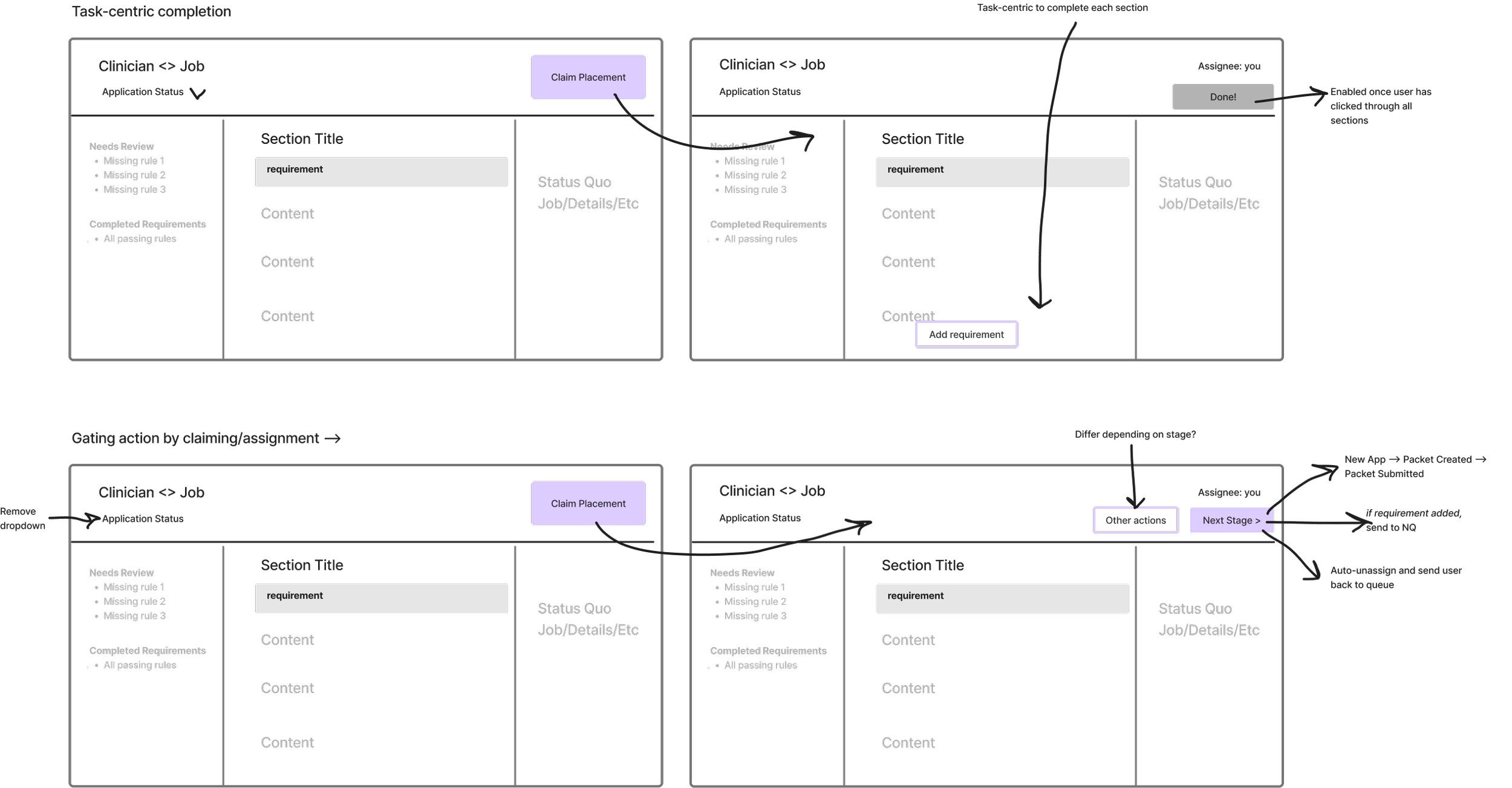
The second, more generalized framework was more well received by end users because it has less click-thru and still left them with the autonomy to complete their larger task with the nuance it required. After iterating with engineers, we also concluded that the this concept would better support future automation work in the crawl-walk-run development.
I refined, iterated, and tested further to ensure the UI was optimized within the end-user’s existing task and workflows with higher-fidelity mock ups.
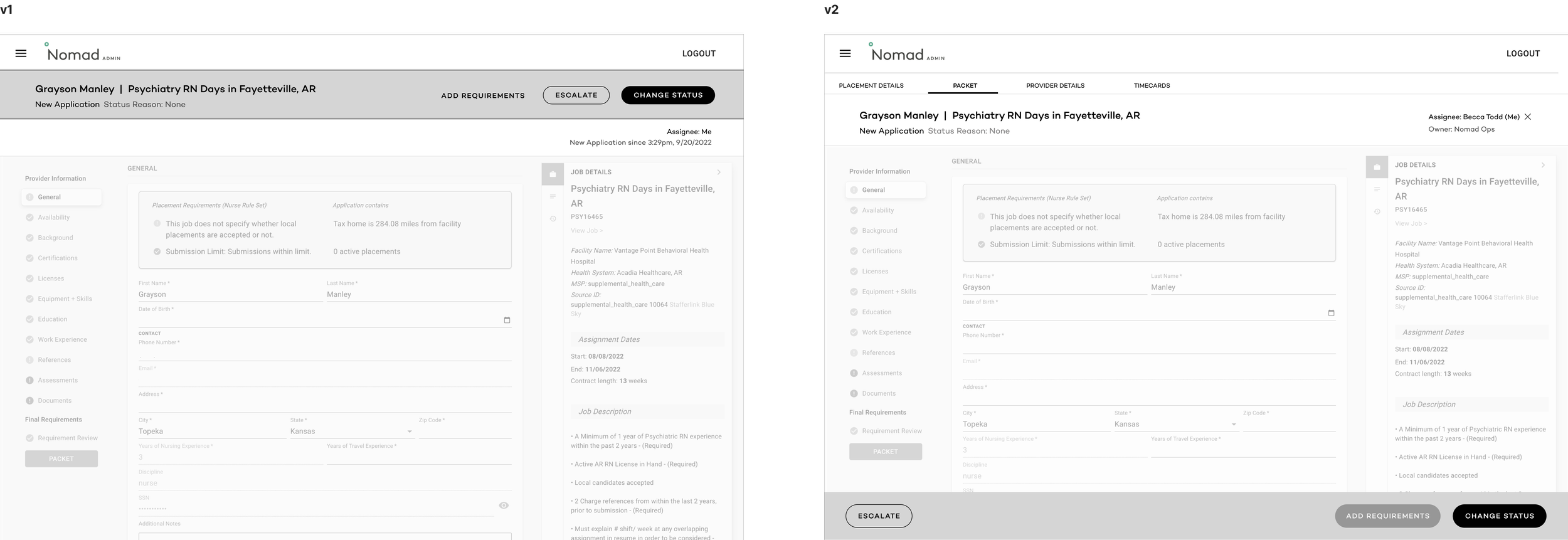
End users unanimously preferred the experience with the tool bar at the bottom of the page, where it felt least distracting and most natural. I created a basic framework to use across the platform to be a repeatable, trainable pattern based on the iterative research.
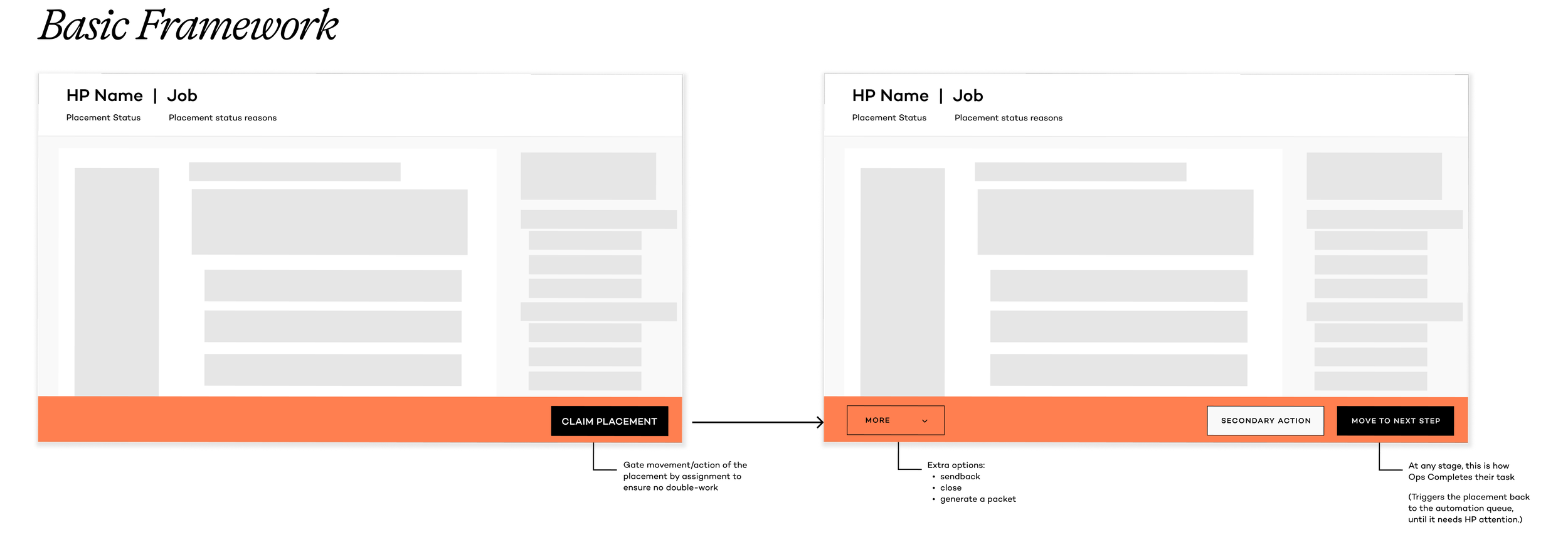
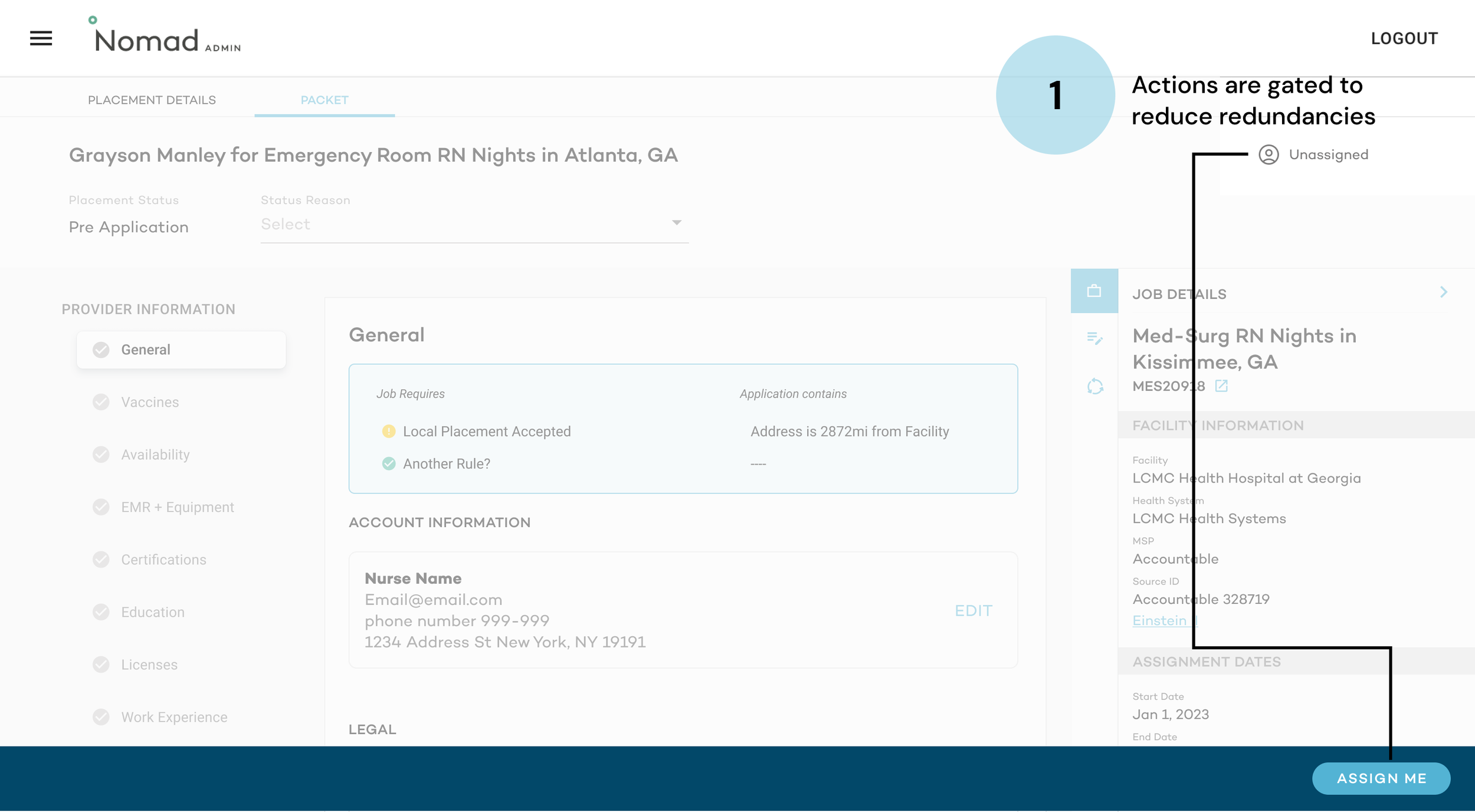
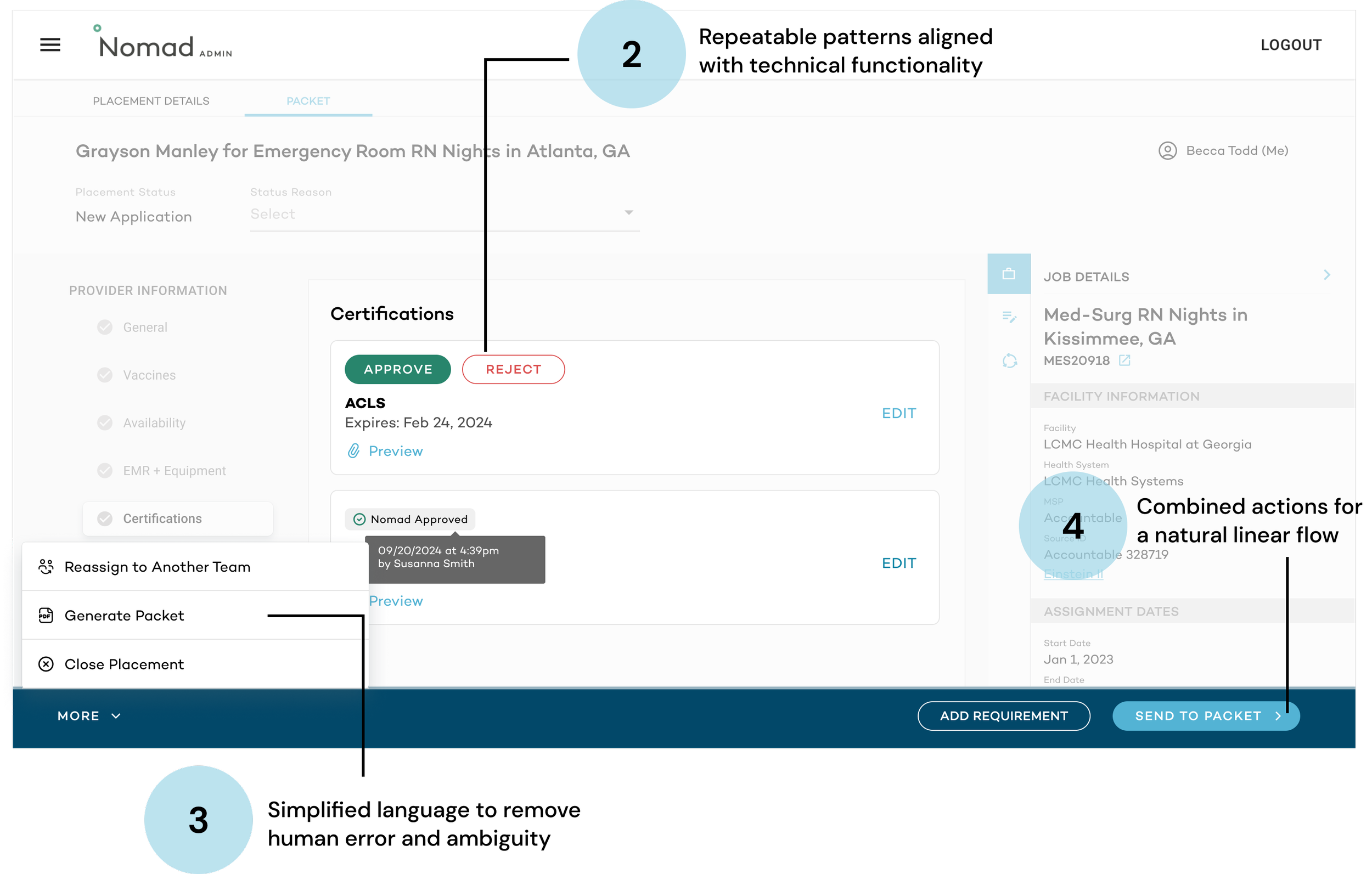
My design decisions centered around simplicity and repeatable patterns.
Gating the main actions behind “assign me” to reduce duplicative work by different users and to better track performance metrics for future business decisions and managers
Repeating patterns to support persistent verification of clinician data from application to application. I used a simple pattern to show approval or rejection that was easily applied across different types of clinician data (certifications, background questions, licenses)
Using plain language and visual cues to clearly instruct users
Combining actions into one step (Next + Un-assign) to simplify actions and anticipate a future automated functionality
Validation
I was wary of a “who moved my cheese” reception to the product’s launch, so I mitigated this by testing broadly with end-users and including small changes that they directly asked for as a way to build alignment and a supportive partnership.
Ultimately, the usability changes were largely positive:
With the original design, processing a placement took 36 clicks. With the redesign, processing the same placement took only 4 clicks, an efficiency improvement of 88%
Additionally, the persistent verification pattern removed redundant reviews of the same data from an estimated 167,000 to 124,000 touches - a 26% decrease.
Future iterations include further automation between steps, leveraging AI to review data and generate submission packets.
Challenges
As with any project, there were several challenges met along the way. Perhaps most notable was the dynamic nature of our ops’ teams workflows – there’s an exception or workaround to every task. While our goal was to create structure to what should be a very linear process, every step needed the flexibility to accommodate inevitable “what if” situations. Capturing all of these secondary situations proved difficult while working with so many cross-functional teams, but our endeavors were successful, and I was able to learn from several colleagues and work across many departments and functions.
This was an incredible engineering feat and largely driven by the need to pair with a new back-end service, so I was working closer than ever with engineers to ensure our actions and goals were in tandem. This project sharpened my collaborative nature as I worked closely with engineering and product to get feedback for visuals, functionality and design needs big and small.