Open Marketplace
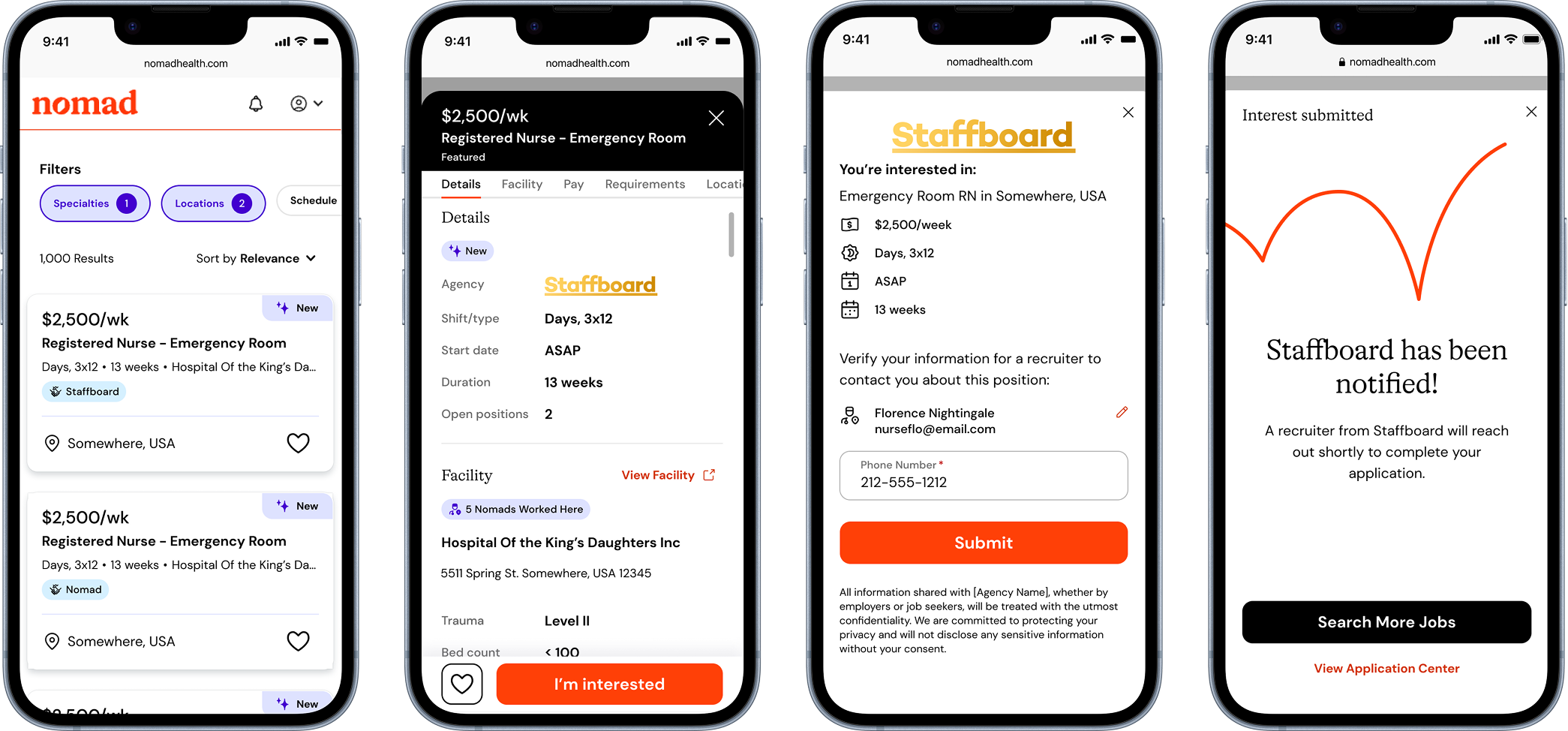
Nomad sought to evolve from a traditional staffing agency and pivot into a dual-sided marketplace, connecting job seekers and other staffing agencies directly. I lead research and design for the net-new product experience serving both sides of the marketplace for a successful launch within eight weeks.
Context + Overview
In 2022, Nomad was named the fastest-growing staffing agency in the US. By 2024, the company aimed to expand its reach by evolving from a traditional staffing agency into a dual-sided marketplace, connecting healthcare clinicians directly with third-party staffing agencies.
My Role: I led research and design for the net-new open marketplace experience, serving both clinicians and agencies, and helped launch the beta product within eight weeks.
The Impact:
Demand side of the marketplace grew 85% within 5 months
Increased ROI for new clients by 32% compared to their competitors
The Problem
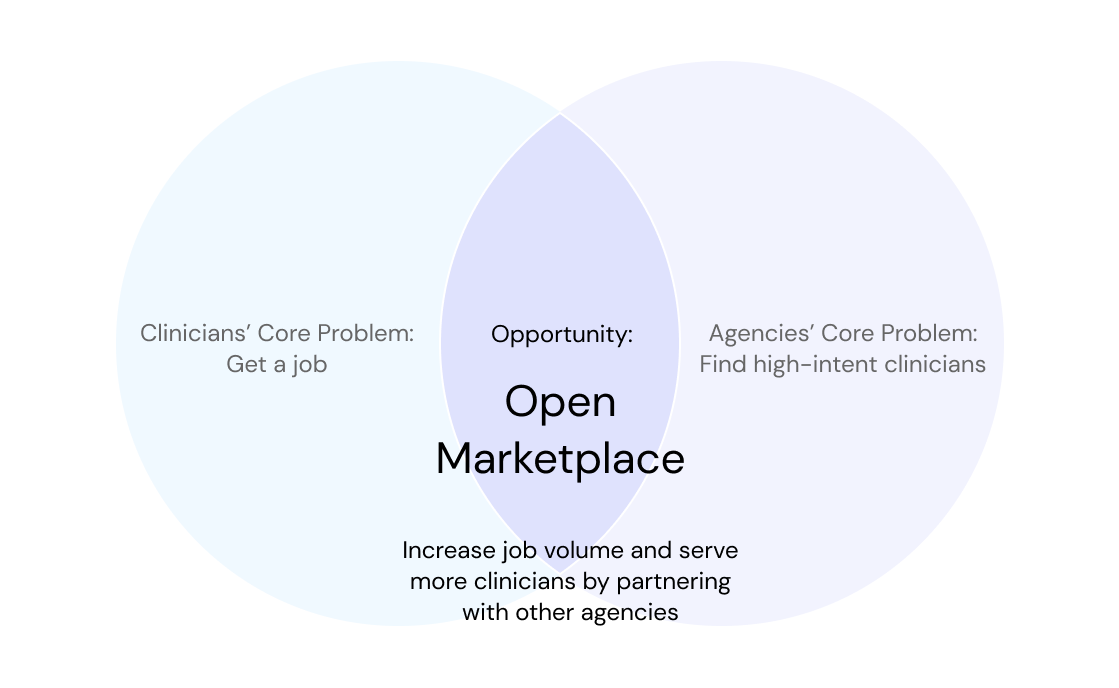
Our challenge was two-sided:
Clinicians: After the peak of Covid, job opportunities were more scarce. Clinicians had to search across multiple sites to find enough opportunities worth applying to.
Agencies: In turn, agencies found their competition also higher and struggled to find high-quality, high-intent clinicians who would convert to offers.
Nomad’s strong track record of candidate conversion created an opportunity to solve both problems simultaneously with an open marketplace.
Research + Discovery
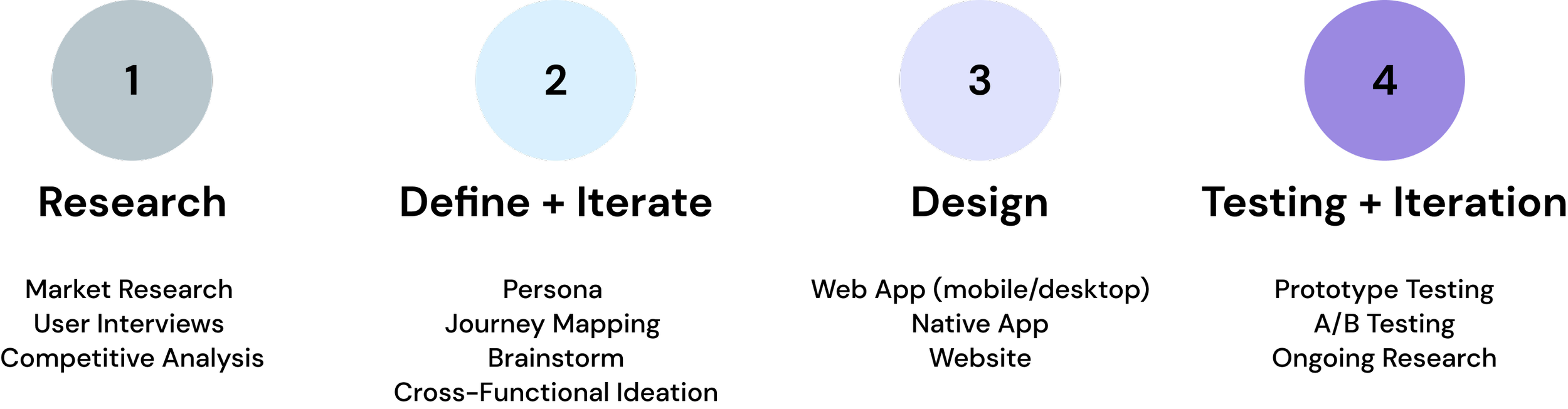
Because the marketplace needed to serve both clinicians and agencies, I ran a blended discovery process:
User interviews: 14 clinicians, including existing users, browsers, and non-Nomad travelers, and 3 agency recruiters.
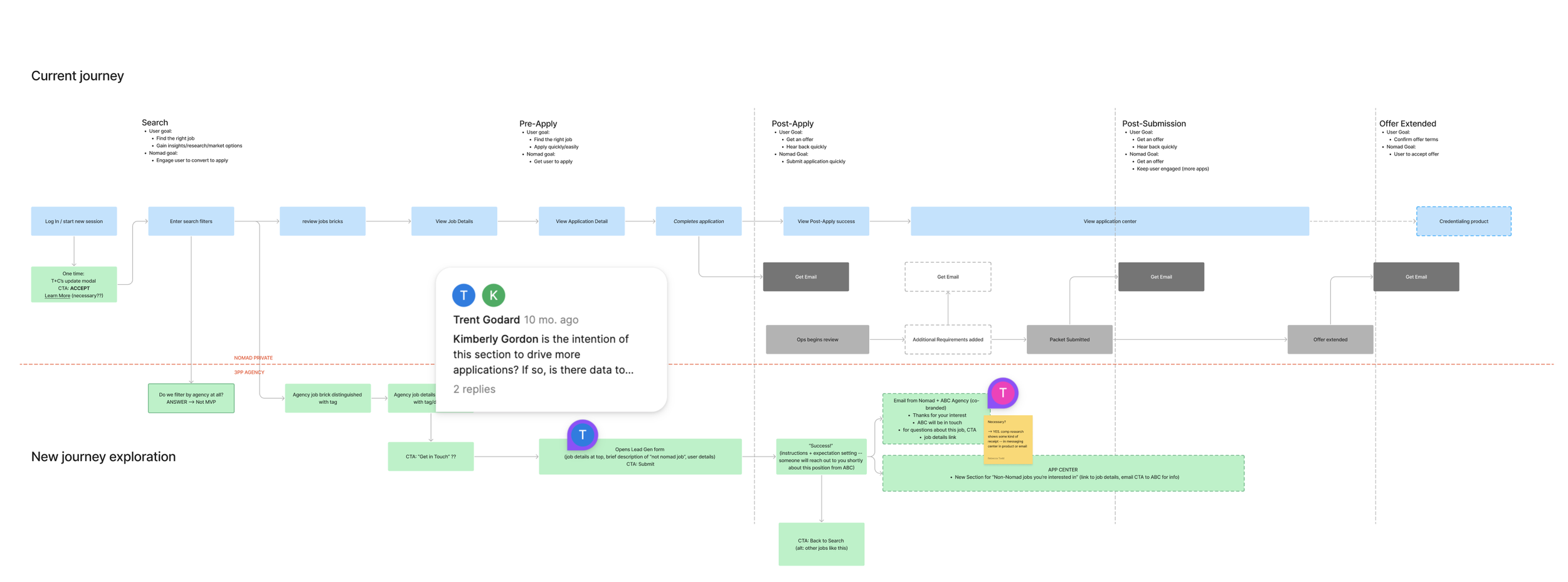
Journey Mapping: Documented the clinician job search, and overlaid it with the proposed open marketplace experience and touchpoints.
Competitive Analysis: Identified gaps and opportunities to differentiate Nomad from similar marketplace platforms and existing competitors
On-site Client Visits: Post-beta launch, I observed recruiter workflows and gathered agency feedback about the tool.
Key Insights:
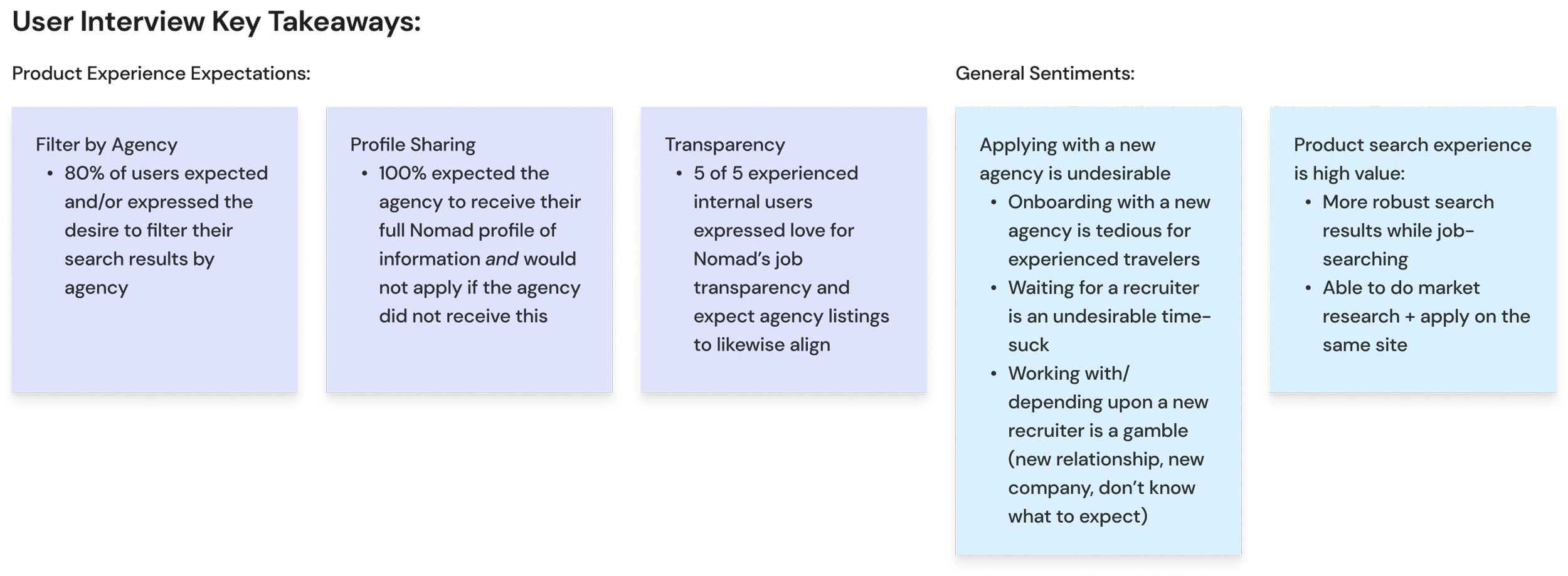
Clinicians valued and expected transparency, information sharing, and autonomy in the marketplace experience
Agencies had parallel expectations — they needed quick access to candidate information to work efficiently and find value in the new experience.
Both groups expected consistency and trust from Nomad as the platform host.
Design
The design challenge was two-fold:
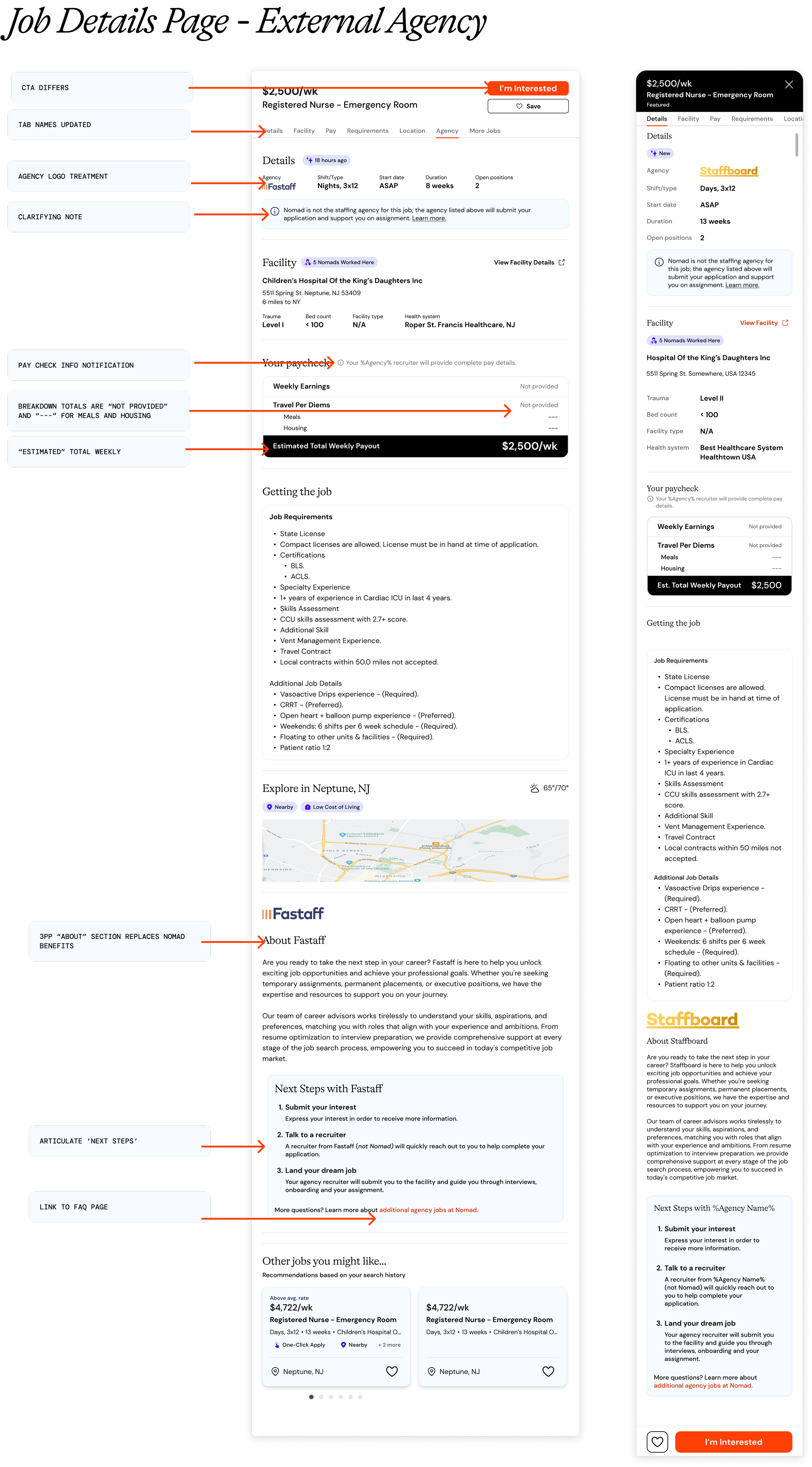
Differentiate the marketplace enough from the pre-exsisting Nomad experience so that clinicians knew to expect recruiter interaction, and
Maintain continuity across agency listings so the product experience felt cohesive for clinicians from start to end.
Key Design Decisions
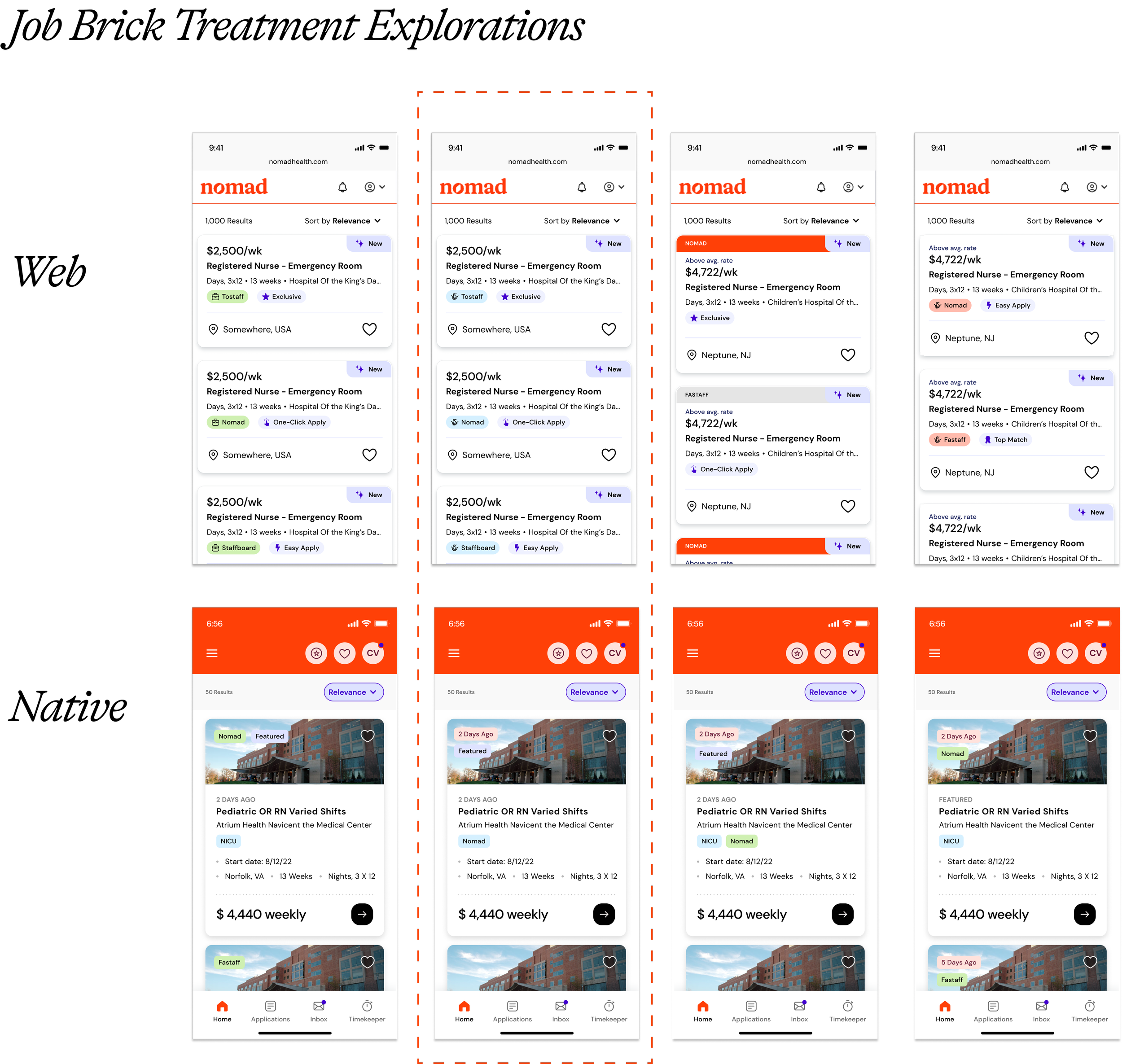
Visual Differentiation: I updated UI patterns on search job bricks and job details pages to signal to returning Nomad users that something new was happening in their flow
Balance of Branding: Nomad’s identity had to evolve from “Nomad, the agency” to “Nomad, the marketplace.” I partnered with senior leadership and marketing teams to weigh the pros and cons of branding under a new umbrella or maintaining the existing (we opted to move forward with the latter for the beta launch).
Information Sharing: I advocated for profile-sharing between candidates and agencies to reduce recruiter inefficiency and a frustrating user experience. While originally deprioritized for beta launch, this quickly became a necessary fast-follow.
Validation
Throughout the beta launch, I conducted usability testing and follow-up interviews.
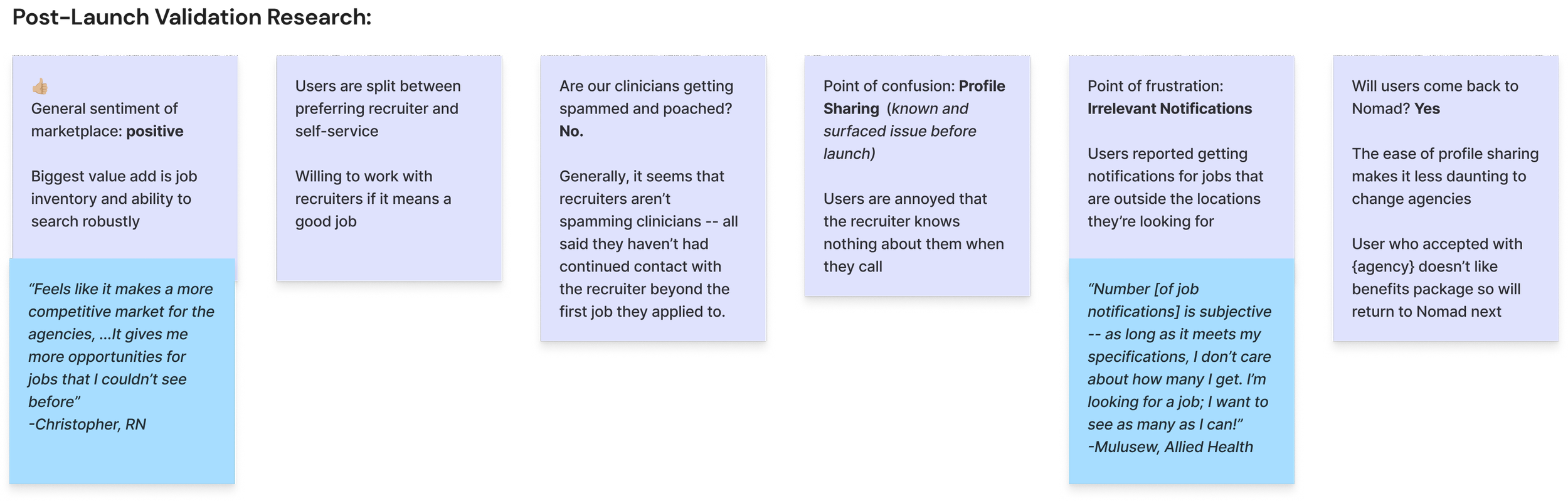
Clinicians expressed frustration when profile sharing was missing from the experience, reinforcing the feedback I had flagged before launch.
Clinicians immediately noticed the increase in job inventory available at Nomad, remarking that the marketplace optimized for their own job search efforts.
Some clients provided poor experiences for candidates; I escalated these findings to our Sales team to push clients to uphold Nomad’s values for transparency and trust.
Agencies overall responded positively to the quality of candidates they received via Nomad’s marketplace and recounted filling Nomad clinicians in roles 30% faster.
Challenges
Out-of-product handoff: Once clinicians left Nomad’s platform to interact with agencies, their experience varied widely, and we had to manually monitor it using surveys and user interviews. This lack of control was a risk for Nomad’s brand and our overall clinician experience.
Brand positioning: Evolving Nomad from agency to marketplace required careful trade-offs in design, marketing and engineering to ensure our cohesive product experience stretched to off-platform comms while still retaining its technical scalability and flattening Nomad jobs against others in the marketplace.
Cross-team alignment: I invited Marketing into user interviews and shared clips/notes to foster user empathy across teams and align messaging with our core user needs.
Future Iterations
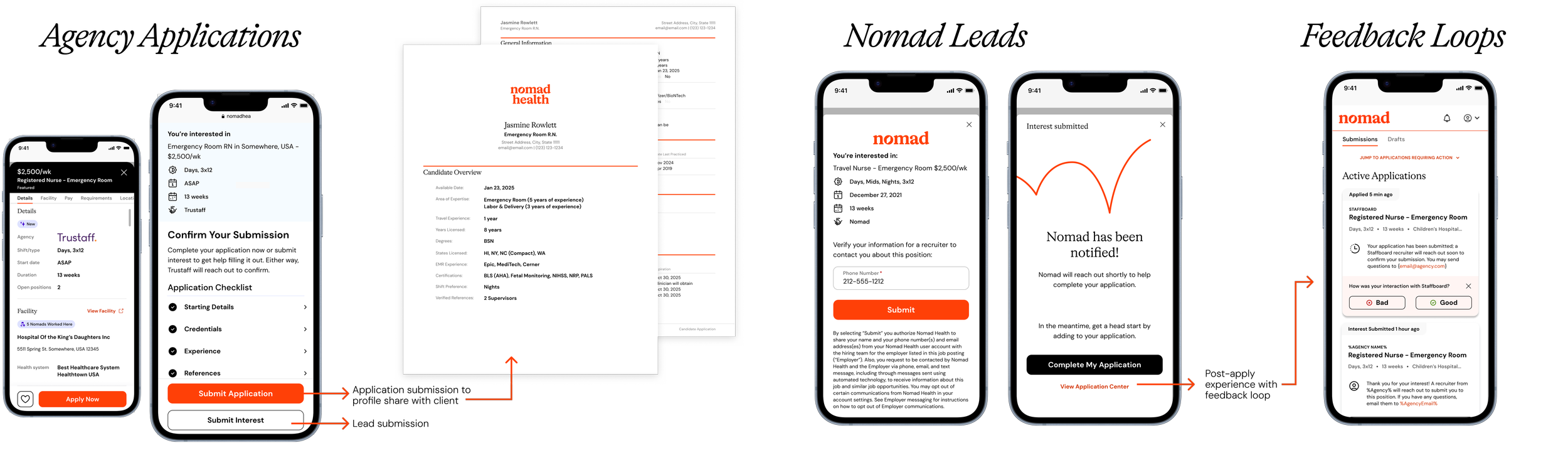
To create parity and scale moving forward, the post-beta launch follow up included the following:
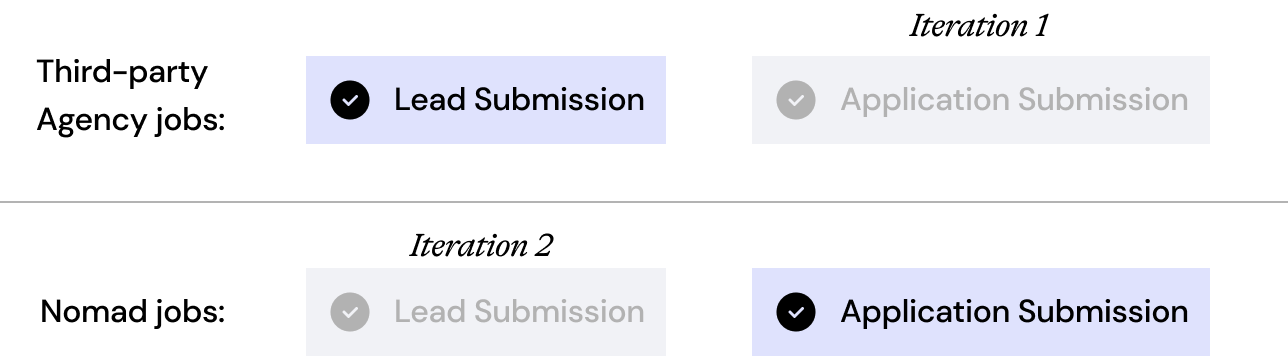
Agency Applications: Enable clinicians to submit completed applications to third-party jobs, rather than just their contact information.
Nomad Leads: Create the pathway for a net-new Nomad recruiter model to create a consistent experience from job to job for clinicians across the marketplace, and to keep Nomad jobs as accessible as its clients
Feedback Loops: Add in-product surveys and feedback to track the post-apply experience for candidates.
Reflection
This project highlighted the complexity of designing for a two-sided marketplace while balancing user needs, business goals, and brand identity.
My biggest takeaway was that launching a net-new experience quickly is only part of the challenge. Designing mechanisms for quality, trust and consistency within the experience and technical implementation is what makes the marketplace truly scalable over time.